

There is a particular kind of sadness that arises when you realize that you and a close friend no longer talk the way you used to. There was no fight. Nothing went wrong, exactly. You simply gradually stopped being the person with whom the other shared their daily life; now, months pass between conversations instead of days. It is easy to interpret this as the end of the friendship. However, most of the time, that is not what has actually happened.

Friendships don't have to stay the same shape forever
Many people tacitly assume that a true friendship must remain unchanged over time: the same frequency, the same closeness, and the same role in each other's lives. But people's lives are constantly changing jobs, relationships, cities, children and a friendship that doesn't adapt to those changes isn't necessarily healthier; it is simply rigid. The friendships that truly endure are often those that transform their dynamics without either party perceiving that change as a loss.
A friendship that once involved daily messages but is now reduced to a long phone call every few months has not necessarily diminished. Often, it involves the same level of closeness, expressed in a way that fits both people's current realities.


Why it feels like grieving, even when nothing bad has happened
Even if you rationally understand that people get busy with their own lives, the emotional experience of watching a friendship become less frequent can truly feel like a loss because, in a sense, it is. You aren't imagining things: you really have lost a version of that friendship the one based on daily contact. What we sometimes overlook is that losing one version doesn't mean losing the friendship itself; it simply implies that the current version hasn't yet been named or accepted.
Honestly acknowledging that change even if only to yourself is usually more helpful than pretending nothing has changed; Pretending otherwise simply leaves that silent grief unprocessed and creates confusion.
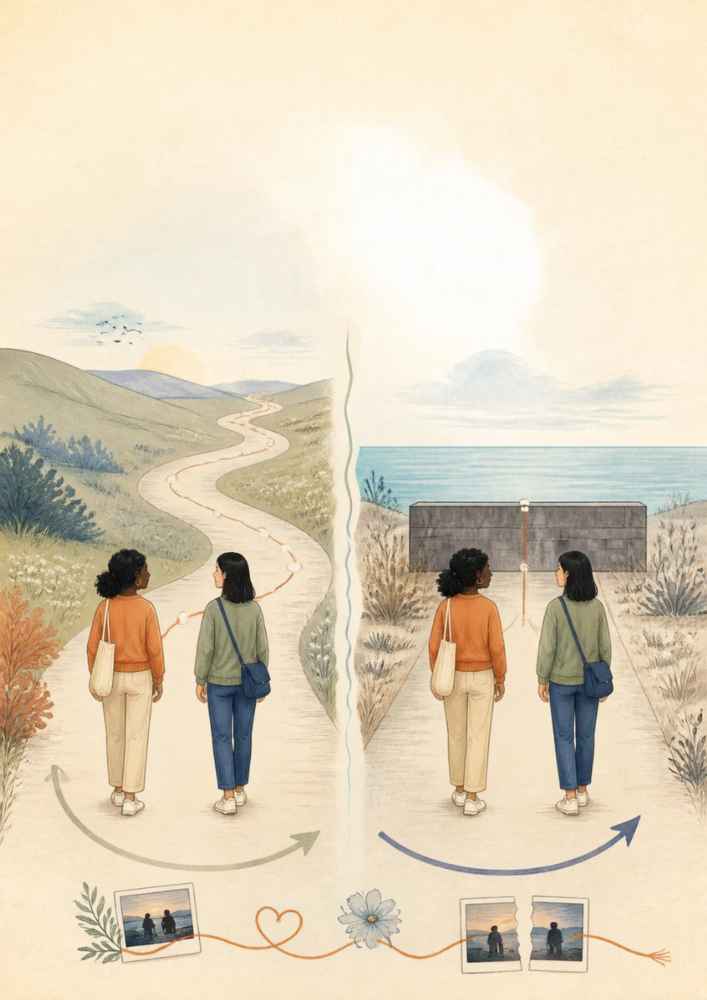
The difference between drifting apart and a definitive end
Gradual drifting is often accompanied by warmth whenever contact resumes: it is easy to pick up where you left off, and the conversation still feels authentic, even if it happens infrequently. When a friendship is truly coming to an end, the feeling is usually different: conversations require more effort, a sense of distance persists even while talking, or one party seems to have no interest in reconnecting.

Frequency of contact is, on its own, an unreliable indicator. The quality of that contact—however sporadic usually offers a much more honest picture of whether the friendship is quietly fading away or simply adopting a new, less frequent dynamic.

It is valid to miss the earlier version of the friendship while simultaneously valuing the current one
It is possible to sincerely miss the closeness you once shared with someone while acknowledging that the current quieter version of the friendship is authentic and worth preserving. These are not contradictory feelings; both are true at the same time. Much of the sadness surrounding friendships that drift apart stems from viewing the situation as a contradiction that must be resolved one way or another.
What really helps
Name the change instead of harboring silent resentment. A simple, low-pressure message something like "I miss talking as much as we used to, though I understand life is very busy" often benefits the friendship more than waiting for things to go back to how they were on their own.
Allow infrequent contact to remain authentic. A friendship does not need daily messages to be meaningful. If the connection feels genuine whenever you speak, it is a sign that the friendship remains intact it is simply operating at a different pace.

Take the initiative without demanding that the other person respond at the same pace. Some of the best, most enduring friendships survive precisely because one or both parties are willing to take the first step from time to time, without keeping score of who initiated the last conversation.
Accept that some friendships are fleeting and that this does not signify failure. Not all friendships are meant to last forever in the same way; some are genuinely tied to a specific stage of life. Acknowledging this honestly is not pessimism; rather, it allows you to appreciate what once was without feeling the need to force it to continue unchanged.

Friendship hasn't disappeared; it has simply changed form.
A shift in the dynamics of a friendship does not necessarily mean it is coming to an end. Most close friendships go through at least one period of distance, busyness, or silence, and the ones that truly matter usually survive it though not by remaining exactly the same.