

When you were a child, you could make a friend in a single afternoon. Physical proximity was enough: being in the same class, living on the same street, or sharing the same playground somehow, that was sufficient to build something authentic. As an adult, months can go by without you making a new close friend, even though you meet plenty of people, and it is easy to think the problem is you. But that isn't the case. The structure that used to do the work for you has simply disappeared.

Proximity used to do the work you now have to do yourself
As a child, you spent hours every day surrounded by the same group of people without having to make an effort to ensure it happened. School organized your schedule. Friendship could emerge almost passively, simply through constant interaction over time.
Upon reaching adulthood, that structure vanishes. You must actively choose to spend time repeatedly with the same people, which requires real effort and intention; what once happened automatically now demands deliberate planning. That is precisely why it seems much harder: because it involves more work now, not because you have lost some social skill you once possessed.

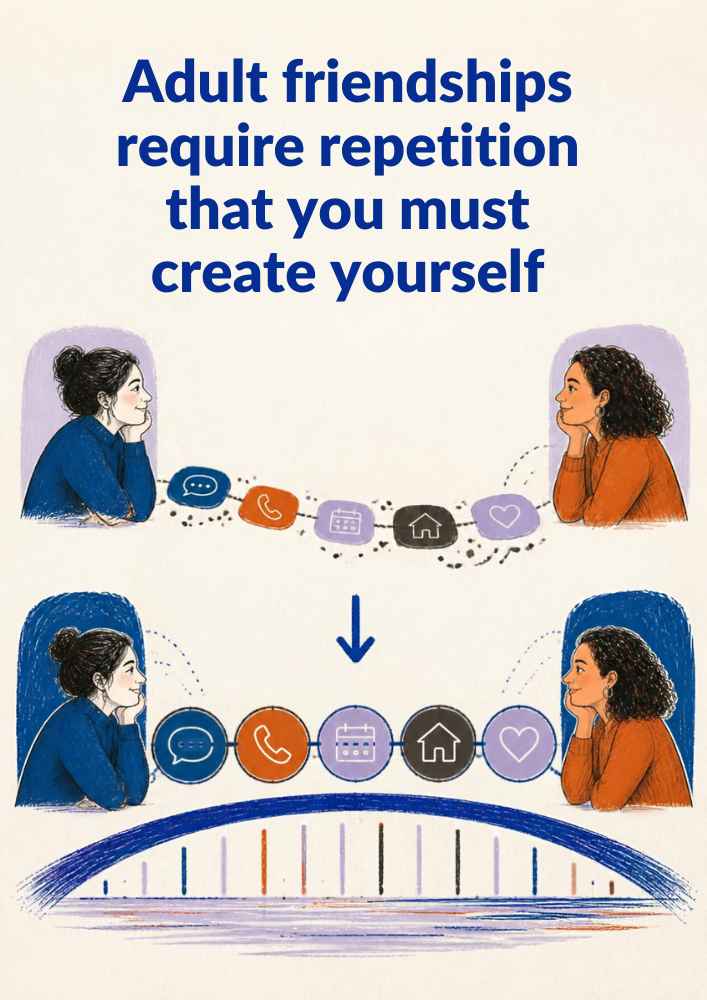
Adult friendships require repetition that you must create yourself
Research on how friendships form points to something simple but important: closeness usually requires a considerable number of shared hours over time; a single good conversation isn't enough. When you were a child, that repetition was built into your daily life. As an adult, you have to schedule it; this involves exercising a very different "social muscle" that requires far more effort than the one you used in childhood.
That is why an excellent first conversation with someone new often fails to turn into a real friendship: a good interaction is not the same as the constant contact friendship needs to solidify, and adult life rarely provides that repetition automatically. It seems like everyone else already has their group of friends, but that is, to a large extent, an illusion.
One of the most discouraging aspects of making friends in adulthood is the feeling that those around you already have an established circle, while you are the only one starting from scratch. In reality, a great many adults are quietly in that same situation: they maintain existing friendships while privately wishing for new ones, yet they don't say so openly because of a tacit social expectation that adults should already have this part of life figured out.
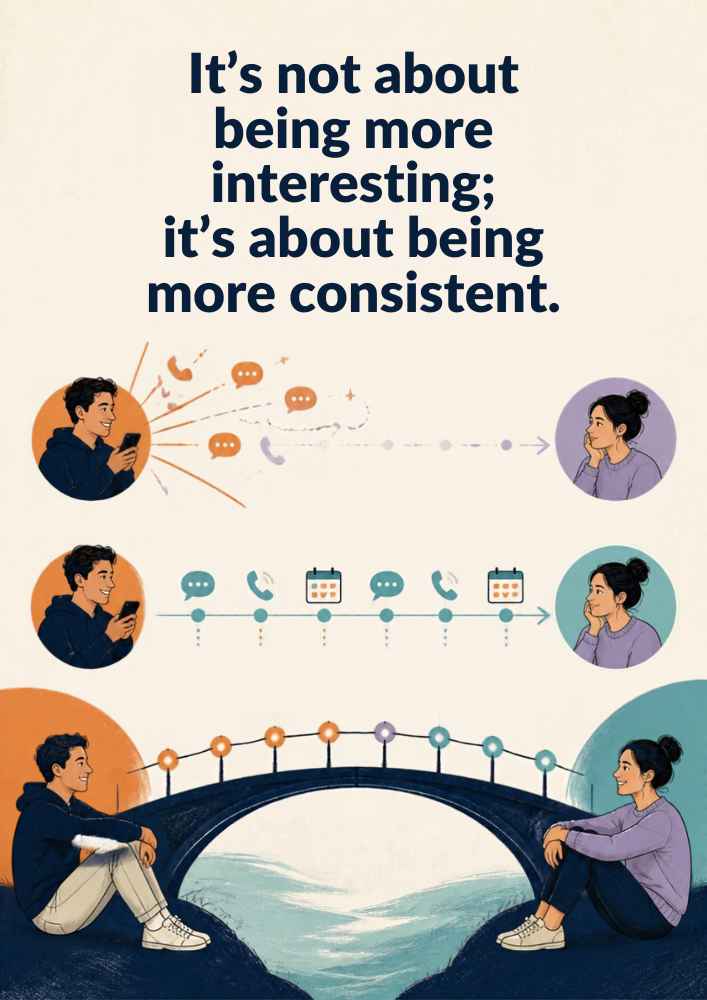

It’s not about being more interesting; it’s about being more consistent.
A common misconception is that making friends as an adult requires becoming more charming, interesting, or impressive in some way. In practice, consistency is far more effective than charisma. Regularly attending the same activity a class, a group, or a recurring meetup tends to foster genuine friendships more reliably than a single, impressive first impression.
What really helps
Prioritize repetition over variety. Attending a recurring activity a weekly class, a regular meetup, or a standing coffee date with the same small group builds familiarity much faster than meeting many new people just once. Depth comes from repeated encounters, not from meeting more people.
Be the one to propose a second meeting. Many promising new connections quietly fade away simply because neither person took the small and perhaps slightly awkward step of suggesting you meet again. Being willing to take that initiative, even if it feels a bit vulnerable, often makes the difference between a pleasant conversation and a real friendship.
Be flexible with your criteria for what constitutes a reasonable invitation. You don’t need a perfect plan to ask someone to hang out. Suggesting "grabbing coffee sometime" is a perfectly normal, low-pressure invitation; Most people appreciate the suggestion far more than you might imagine.

Devote more time to it than feels natural. Adult friendships often take longer to solidify than we would like not because something is wrong, but because the repeated contact that fosters closeness takes longer to build up when there is no pre-existing structure to force it. Here, patience isn't passivity; it’s a realistic view of how things work at this stage of life.
Accept that taking the initiative is more necessary now than it used to be. In childhood, friendships could form on their own; in adulthood, however, they require actively choosing and being chosen repeatedly and deliberately. This shift is not a personal failing, but simply the nature of adult social dynamics.

There is nothing wrong with you; the structure has simply changed.
If making friends feels harder now than it did years ago, it doesn’t mean you are less likable or that you’ve lost social skills along the way. It is a structural change: the automatic repetition that once forged friendships for you is gone, and recreating them now requires conscious effort. That effort is real, but it is also something that can be learned; it is simply a different type of social interaction than the one you were used to while growing up.